
Influencer marketing is an effective tool in the marketing toolbox when it comes to convincing consumers to buy your particular product.
We have found that influencers are very powerful at moving consumers who have some knowledge of your brand towards the decision to actually buy your product. At the same time, influencers can convert consumers from considering the product or consuming it to actually creating preference, and in the best case scenario, loyalty, for the product by showing the consumer that other people - perhaps even their favorite influencer - are using that particular brand.
Analysis from eMarketer has documented that influencers can also significantly increase the effectiveness of your marketing in other channels. This is also called multiplier effects and works in both the short and long term. It works like this: when people see an advertisement from an influencer before they see an advertisement for the same product on TV, Facebook or YouTube, they tend to react significantly more positively, which increases the effectiveness of those advertisements.
Influencers are not a “one size fits all”. They come in many shapes and sizes, from opinion leaders who have great knowledge and are experts in their own niche, to Instagrammers who take great pictures of the world, to models who look good in pictures, and all the way to people like The Kardashians and the more “classic” influencer who shares their life and thoughts with a number of followers. In addition, we also have a new type of influencer popularly called “creators”. These are people who are excellent at using the technical tools that individual platforms give them to create enriching and interesting content.
If we go even further down, you can segment by platforms, YouTubers, Instagrammers, Twitch streamers, Tik Tok'ers, etc.
And another layer further down, their niche/segment, such as mommy, fitness, gaming, lifestyle, fashion, etc. More on this later.
Choosing the right influencer requires a strong strategy and understanding of what your campaign or brand effort needs. For example, if you need to explain how to use a product, it may be necessary to hire influencers who are strong in video. Certainly not all influencers who have been used to working with still images and text can easily convert themselves to being someone who speaks in videos. In fact, it often goes really wrong and the content becomes that way.
To get the most out of your influencer marketing, it needs to make sense for the brand, the influencer, and the primary target audience. It's therefore important that we take all three components into consideration when finding the right influencers.
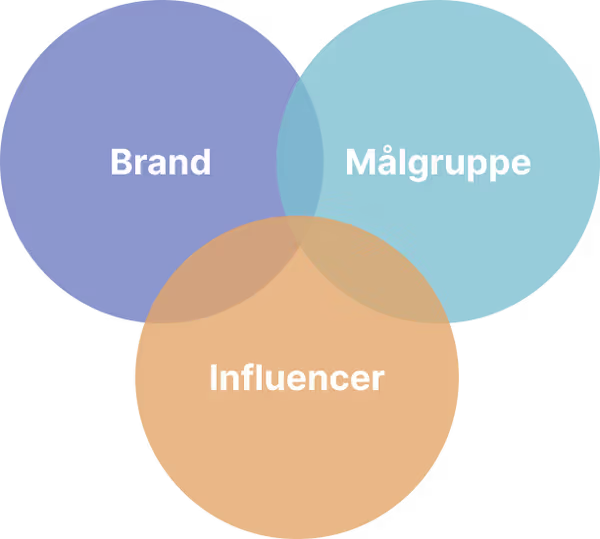
From here it will be relevant to take a closer look at the selection criteria we must take into account when selecting our influencers, to ensure that all three components are taken into account. We have chosen to divide them into quantitative and qualitative selection criteria , respectively .
Quantitative selection criteria
Looking at the quantitative selection criteria, one of the most common and most used methods has been to look at the influencer's number of followers. When we divide influencers based on the number of followers, we segment them by the size of the influencers, typically dividing them into four sizes: Nano-, micro-, macro-, and mega-influencers .
Nano influencers : are influencers with less than 1000 followers and are the newest type. They are described as a completely ordinary person who communicates a message among their friends.
Micro influencers : are influencers with between 1000 and 20,000 followers. These influencers often appear very credible. Their relatively few collaborations mean that they do not seem so commercial. However, this also means that they have less experience, which can contribute to a lower quality of content.
Macro influencers : have between 20,000 and 200,000 followers. These influencers have a solid reach, while also managing to engage their followers. However, it should be noted that there can be a big difference between an influencer with 25,000 followers and 150,000 followers, but both will typically be characterized by a stable reach combined with interaction.
Mega influencers : have 200,000+ followers. They are typically considered celebrities and have a kind of idol status, especially among the younger target audience. These influencers have a very large reach and are super professional in their way of conducting collaborations. The disadvantage of this type is that there is typically very little personal interaction from the followers.
Reach & engagement
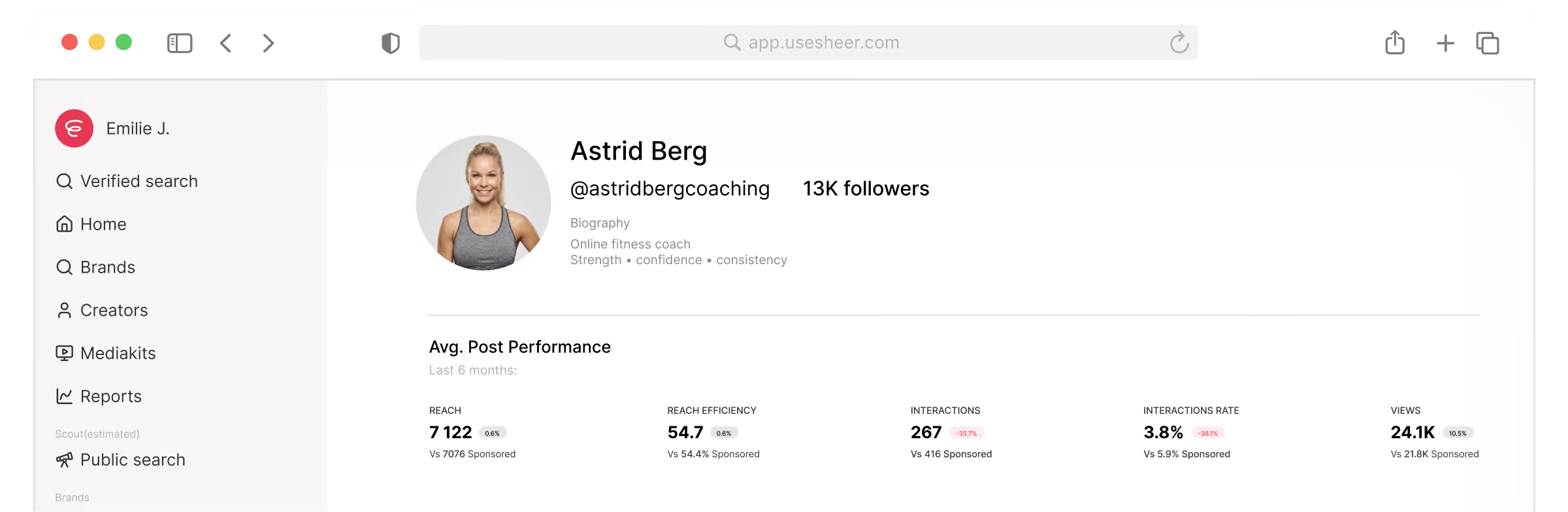
However, looking solely at the number of followers does not give a full picture of how well an influencer is performing. It is more important to focus on the influencer's reach and engagement.
This gives you a much better idea of how many people the influencer actually reaches and how many of the influencer's followers actually engage with the content they produce. It gives an indication of how good the influencer is at creating inspiring content for their followers.
And if you want to go a step deeper, you also look at reach in target audience and engagement in target audience. That is, how many people a given influencer reaches and engages in the specific target group you want to reach.
In general, the rule of thumb is that the bigger the influencer, the less engagement they have - that is, the involvement of their followers. This is natural, but also something worth noting if the goal of the campaign is to create conversations and/or more active involvement for your brand. Here, it can be more useful to use smaller influencers (10,000-50,000 followers), as they typically have a higher level of engagement and a high level of trust in the recommendations they give, whereas the larger influencers (200,000+) are more relevant when you want to reach as many people as possible, as their reach will, naturally, often be higher.
Qualitative selection criteria
Taking raw data into account is certainly an important part of the selection process, but often the qualitative selection criteria are more important, as the less successful collaborations are typically a result of a mismatch on the qualitative criteria in particular.
When assessing whether the influencer is a good match based on qualitative criteria, you should take into account the type of influencer (segmentation), output/format, focus, type, tone, style and values, brand and target audience match, and the quality of the content.
Types of influencers (segmentation of influencers)
As mentioned earlier, there are many ways to segment influencers. We will now go over different ways you can segment influencers.
Output/format
Output refers to what content the influencer produces. The content the influencer produces tells you something about which platform the influencer uses most frequently and what type of content the influencer is best at.
Typically, we distinguish between the following formats: Image format, video format, text format and audio format.
Influencers who use the image format have a good command of camera techniques and know how to edit and present high-quality visual content. The primary platforms for this format are Instagram and Pinterest.
When it comes to video format, we distinguish between long format and short format. Long format videos are longer videos, typically 5+ minutes, where the influencer goes into more depth with a topic than you would see in image format, for example. This content is suitable for YouTube.
Short format videos are videos that can last less than 30 seconds and up to 1 minute. These videos can be fun clips of glimpses from everyday life that often focus on some kind of activity. This format is suitable for platforms like Instagram, TikTok and Snapchat.
In text format, the focus is on the written word. The influencer writes about current events, trends, products, parties, etc. This typically happens on blogs. Their blog is well-known and respected and their words carry weight. At the same time, the content they create has SEO benefits for a brand.
Audio format is often seen in connection with podcasts. Here, the influencer often deals with one specific topic and goes into depth with that topic. Influencers who use audio format can be people who have expertise within a specific area that they discuss, but they can also be people who discuss various topics based on personal opinions. Collaborations typically take the form of sponsorships or recommendations.
Focus
Influencers can have different focuses (or “points of view”) in their content production. When we talk about influencers with inward-facing cameras , it’s mostly about themselves, what they wear, where they eat, how they get ready (daily routines). These influencers are often considered beautiful, are well-known faces and can be partly categorized as models.
Influencers who use outward-facing cameras are characterized by taking high-quality photos of people other than themselves. The photos are often aesthetically pleasing and have a common theme. These influencers are recognized for being skilled within a specific category/industry.
Type/category
We can also segment influencers by content category. Here we focus on which category the influencer's content primarily deals with. An influencer can rarely be put into a single category, but often has a primary category.
Some examples of the most common categories could be: Fashion, fitness and training, beauty, food and baking, interior design, gaming, etc.
The most common categories are categories where the products are seen as “Insta-friendly” - that is, products that can be used to create beautiful and aesthetic content. However, it is important to emphasize that it is not only effective to do influencer marketing with “Insta-friendly” products, it is simply these products that are most common within influencer marketing.
If you use multiple types of influencers in one campaign, it is important to consider the role of each influencer and what type of content they should each create to maximize the benefit. Different types of influencers create different values.
For example, if we want to showcase our products in an aesthetic and beautiful way, we should look for influencers with outward-facing cameras. On the other hand, if we want to create involvement and create a stronger bond between brand and consumers, an influencer with an inward-facing camera would be a better solution.
Tone, style and values
The influencer's tone, style and values relate to how the influencer communicates their message as well as the visual expression/style the influencer stands for. The influencer's values also have a major impact on the credibility of the content. If we can identify a mismatch between the brand's and the influencer's tone, style and values, we will most likely see an unsuccessful collaboration. An extreme example would be if the influencer is active in the fight against smoking and creates sponsored content related to cigarettes, this will seem very untrustworthy, as the influencer's values contrast with the brand's values.
Brand and target audience match
The above can be related to brand and target audience match, where we assess to what extent the influencer's own brand matches the brand's values and how the influencer's target audience matches the brand's own target audience. It probably sounds more complicated than it actually is. Let's take an example: If you want to advertise your dresses, which are made from sustainable materials, it would not make sense to use an influencer whose followers are 80% men, who are also not interested in the environment at all, since we must assume that the primary target audience for sustainable dresses is mainly environmentally conscious women. There will therefore be a mismatch between the influencer's target audience and brand values and the company's target audience and brand values.
Content quality
A final qualitative criterion that is relevant to your selection is the quality of the content. As a rule of thumb, the influencer's content should be easy to relate to. Easily relatable content is usually inspiring, entertaining, and honest.
And when it comes to content quality, some content is simply better than others. Some may be skilled at creating aesthetically pleasing, beautiful images, while others are sharp when it comes to making longer, entertaining videos.
It is important to emphasize that it is not only about the visual quality of the content, but also the substantive quality. This assessment will of course always be subjective, but it is simply important that you make an overall assessment of what you yourself believe is good content, according to the campaign.
All of this boils down to the risk assessment you should take when selecting your influencers. Always consider to what extent your choice of influencer will affect the message you want to get across.
Key take aways:
- Choosing the right influencer for your campaign helps create preference and loyalty for your brand.
- Quantitative selection criteria may be useful in some cases, but do not give the full picture.
- It is necessary to use qualitative selection criteria to avoid a mismatch between influencer and brand.
If you are thinking about running influencer campaigns, but find it too confusing to get started or find the right influencer, don't hesitate to contact Sheer - we are always ready to help with building and managing your influencer campaigns.